
Introduction
Over the past decades, advances in molecular genetics have transformed the study of complex human traits and multifactorial diseases. Disorders such as hypertension, obesity, diabetes, cardiovascular disease, and neurodegenerative conditions are now recognized as the product of intricate interactions between multiple genes, environmental exposures, and regulatory biological networks. Within this context, single nucleotide polymorphisms (SNPs) have emerged as fundamental molecular markers driving progress in genetic epidemiology, genome mapping, precision medicine, and disease risk prediction.
The rapid development of high-throughput sequencing, large-scale genotyping platforms, and genome-wide analytical tools has led to an unprecedented expansion in SNP discovery and cataloging. Major industrial, academic, and governmental initiatives have contributed to building extensive SNP databases and improving genotyping technologies capable of analyzing thousands of genetic variants simultaneously. However, the scientific value of these resources lies not merely in generating polymorphism catalogs, but in applying them strategically to uncover biologically meaningful associations, identify disease susceptibility loci, and improve translational outcomes.
Today, SNP research sits at the intersection of population genetics, molecular epidemiology, bioinformatics, pharmacogenomics, andfunctional genomics, offering powerful opportunities to understand disease mechanisms at both the genomic and population levels.
The Biology of Genetic Polymorphism
Understanding Polymorphisms in the Human Genome
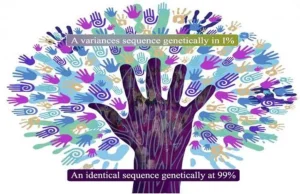
A genetic polymorphism refers to a DNA sequence variation present at a frequency greater than 1% within a population. These variants represent a major source of human genetic diversity and can influence phenotype, disease susceptibility, drug metabolism, and physiological adaptation.
Polymorphisms arise through mutation and are maintained through evolutionary forces including genetic drift, recombination, natural selection, and demographic history. Their study forms the foundation of modern genetic epidemiology.
Several key biological questions have historically driven polymorphism research:
- Which types of DNA variation contribute to phenotypic diversity?
- How are polymorphisms maintained within populations?
- How can genetic variants be linked to observable traits and disease risk?
- By what molecular mechanisms do sequence variants influence phenotype?
While conceptually straightforward, answering these questions remains challenging because genetic variation ranges from single-base substitutions to large structural alterations, each with distinct functional consequences.
Single Nucleotide Polymorphisms (SNPs)
Among all forms of genetic variation, single nucleotide polymorphisms (SNPs) are the most abundant and extensively studied. A SNP involves the substitution of one nucleotide base for another at a specific genomic position.
SNPs occur throughout the genome, including:
- Coding regions (exons)
- Introns
- Promoter regions
- Enhancers
- Untranslated regions (UTRs)
- Intergenic sequences
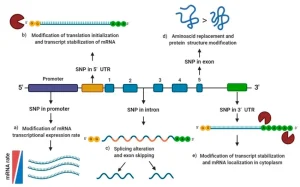
Depending on their genomic location, SNPs may:
- Alter protein structure through nonsynonymous substitutions
- Affect transcription factor binding and gene regulation
- Modify RNA splicing patterns
- Influence mRNA stability
- Change susceptibility to disease or therapeutic response
Current estimates suggest SNPs occur approximately every 300–1000 base pairs across the human genome, making them the most abundant class of polymorphism available for gene mapping and association studies.
Their abundance, genomic distribution, and functional potential explain why SNPs have become central tools in genetic epidemiology.
Other Forms of Genetic Polymorphism
Although SNPs dominate modern genetic studies, other polymorphic markers remain important.
Microsatellites and Short Tandem Repeats (STRs)
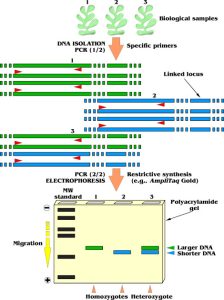
Microsatellites, also known as short tandem repeats (STRs), consist of repeated di-, tri-, or tetranucleotide motifs. Because repeat numbers vary considerably between individuals, these markers are highly polymorphic and useful for:
- Linkage analysis
- Population structure studies
- Forensic genetics
- Evolutionary analysis
Their high heterozygosity made them indispensable in early genome mapping.
Variable Number Tandem Repeats (VNTRs)
VNTRs, or minisatellites, represent larger repeated DNA motifs that also display substantial allelic diversity. They have historically been used in linkage mapping and studies of genomic variability.
Insertion/Deletion Polymorphisms and Alu Elements
Insertion/deletion polymorphisms (indels) involve the gain or loss of DNA fragments.
One notable example includes Alu insertion polymorphisms, which serve as stable genomic markers and contribute to structural genomic variation.
Although less abundant than SNPs, these polymorphisms remain useful in specialized applications.
Traditional Uses of Polymorphism in Gene Mapping
Linkage Mapping and Positional Cloning
Before the rise of SNP-based association studies, polymorphisms were primarily used in linkage analysis to identify chromosomal regions associated with disease.
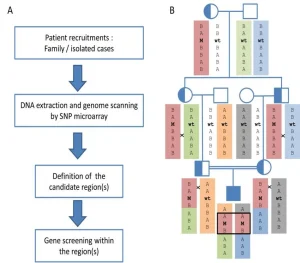
Linkage mapping tracks co-segregation of marker alleles and disease traits within families across generations. If a marker is physically close to a disease locus, recombination is less likely to separate them.
This principle enabled positional cloning, a strategy that led to the discovery of numerous disease-associated genes.
Microsatellite markers were particularly valuable because their high polymorphism improved detection of inheritance patterns.
However, traditional linkage analysis has major limitations for multifactorial diseases because:
- Most common diseases involve many genes with small effects.
- Large family datasets are required.
- Statistical power is often low.
- Resolution for locating causal variants is limited.
These limitations drove interest toward denser marker systems, particularly SNPs.
Why SNPs Became Central in Genetic Analysis
High Genomic Abundance
One of the major advantages of SNPs is their extraordinary abundance.
Because SNPs occur at very high density across the genome, they provide:
- Fine-scale mapping resolution
- Improved positional cloning power
- Better coverage for genome-wide studies
- Greater likelihood of detecting causal variants
This density makes SNPs ideal markers for complex trait dissection.
Functional Positioning Within Genes and Regulatory Regions
Unlike many neutral markers, SNPs often occur in biologically relevant genomic regions.
Functional SNPs may influence:
- Protein coding sequences
- Regulatory networks
- Epigenetic interactions
- Transcriptional activity
- Signal transduction pathways
This increases their utility not only as markers but also as direct candidates for causal disease mutations.
Linkage Disequilibrium and Haplotype Analysis
Neighboring SNPs often show linkage disequilibrium (LD), where specific alleles tend to be inherited together.
These correlated variants form haplotypes, which can capture inherited genomic signatures associated with disease susceptibility.
Haplotype-based analysis improves:
- Association mapping
- Disease gene localization
- Population genetic inference
- Reconstruction of ancestral mutation patterns
Modern haplotype analysis remains a cornerstone of human genetics.
High-Throughput Genotyping Efficiency
SNPs possess a simple molecular structure that makes them highly compatible with automated genotyping technologies, including:
- DNA microarrays
- SNP chips
- Next-generation sequencing
- Mass spectrometry genotyping
- PCR-based allelic discrimination assays
These platforms allow large-scale population studies at reduced cost and high analytical throughput.
Genetic Stability
Compared with repetitive markers, SNPs show lower mutation rates and greater stability across generations.
This improves reliability in:
- Linkage disequilibrium studies
- Population association studies
- Ancestry analyses
- Evolutionary inference
Their stability makes them particularly valuable for long-term epidemiological studies.
Applications of SNPs in Genetic Epidemiology
SNP-Based Gene Discovery
One of the most important uses of SNPs is identifying genes involved in disease susceptibility.
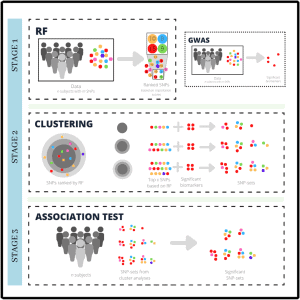
SNP-based mapping strategies include:
Linkage Mapping
Dense SNP panels improve localization of disease loci through refined co-segregation analysis.
Linkage Disequilibrium Mapping
LD mapping exploits historical recombination patterns across populations to detect disease-associated genomic regions with higher resolution than classical linkage methods.
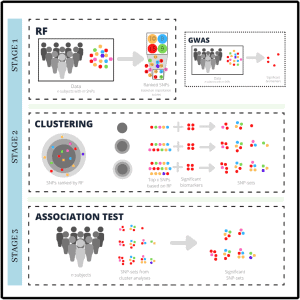
Genome-Wide Association Studies (GWAS)
GWAS represents a major extension of SNP-based epidemiology.
By scanning millions of SNPs across the genome, GWAS has identified thousands of loci linked to:
- Obesity
- Hypertension
- Cancer
- Autoimmune disorders
- Diabetes
- Neurological disease
These studies have reshaped complex disease genetics.
Candidate SNP Association Testing
Beyond indirect mapping, SNPs can be tested directly as functional candidate polymorphisms.
Candidate SNP studies aim to determine whether specific variants:
- Alter disease risk
- Influence phenotype expression
- Affect biological pathways
- Modify treatment outcomes
Such studies remain central in molecular epidemiology, although they require careful control for:
- Population stratification
- Multiple testing bias
- False positives
- Confounding effects
Robust study design remains critical.
SNPs in Disease Diagnostics and Risk Prediction
Genetic Risk Profiling
Once disease-associated SNPs are validated, they can contribute to predictive models of disease susceptibility.
SNP-based risk profiling is increasingly applied in:
- Polygenic risk scores
- Preventive medicine
- Personalized screening
- Early disease prediction
For multifactorial disorders, combining multiple SNPs often improves predictive power relative to single-marker models.
Precision Diagnostics
SNP biomarkers can support diagnostic and prognostic tools by identifying individuals at increased risk or likely to exhibit specific disease trajectories.
However, successful translation requires