
Introduction
The introduction of combination antiretroviral therapy (ART) transformed HIV infection from a fatal disease into a chronic manageable condition. Modern ART aims not only to suppress viral replication to undetectable levels, but also to restore immune function, reduce HIV-associated morbidity, prolong survival, improve quality of life, and prevent onward viral transmission. In most patients, the use of at least three active antiretroviral agents can maintain plasma HIV RNA below detectable thresholds for years, often leading to durable virologic control and immune recovery.
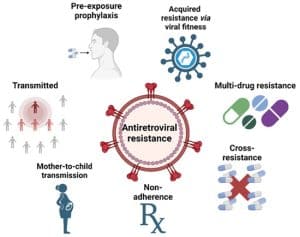
Despite these remarkable advances, HIV-1 drug resistance remains one of the most important obstacles in long-term treatment success. Resistance is deeply rooted in the biology of the virus itself. HIV replicates rapidly, mutates continuously, and generates extraordinary genetic diversity, allowing resistant variants to emerge spontaneously or be transmitted between individuals.
This capacity for adaptation means that resistance may exist before treatment begins, arise during therapy due to incomplete viral suppression, or accumulate progressively under drug pressure. In all cases, resistance threatens treatment efficacy, narrows future therapeutic options, and increases the risk of virologic failure.
Today, resistance testing, improved drug design, and the availability of newer drug classes have dramatically improved the management of resistant HIV infection, even in many cases involving multidrug-resistant (MDR) virus. However, because ART is lifelong and the development pipeline for new compounds remains uncertain, preserving the activity of current therapies has become a central priority in HIV medicine.

HIV Resistance as a Consequence of Viral Diversity
The Quasispecies Nature of HIV
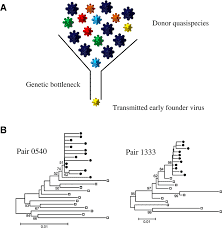
A defining characteristic of HIV-1 is its existence as a viral quasispecies rather than a single uniform genotype. Within every infected person, the virus circulates as a dynamic swarm of related variants, each carrying small genetic differences.
This extraordinary diversity results from:
- Error-prone reverse transcription
- Lack of proofreading by reverse transcriptase
- High daily replication rates
- Frequent recombination events
- Continuous selective pressures from immunity and therapy
Because of this, essentially every possible single-point mutation and many double mutations can be generated daily during active replication.
This creates a viral population primed for escape.
Under no drug pressure, wild-type viruses usually dominate because they possess the highest fitness. But under suboptimal therapy, resistant variants can gain a selective advantage and rapidly expand.
This evolutionary flexibility underlies nearly all antiretroviral resistance.
Resistance Is a Continuum, Not an All-or-Nothing Event
Antiretroviral resistance is not simply “present” or “absent.” Rather, resistance exists along a continuum.
Some mutations cause only partial reductions in susceptibility, which may be overcome by higher drug concentrations. Others confer high-level resistance that renders drugs largely ineffective.
Resistance is commonly measured by shifts in:
- IC50 (50% inhibitory concentration)
- IC90 (90% inhibitory concentration)
- Fold-change in susceptibility compared with wild-type virus
This continuum has major clinical implications, because partially active drugs may still contribute antiviral activity in salvage regimens.
Replication, Genetic Barrier, and Resistance Evolution
Why Ongoing Replication Drives Resistance
Resistance emerges when viral replication persists in the presence of drug pressure.
Three scenarios illustrate this principle:
Low-Potency Regimens
Weak regimens exert minimal pressure and may allow slow resistance evolution.
Intermediate Potency Without Full Suppression
These create ideal conditions for resistance:
- Enough pressure to select mutants
- Enough replication for those mutants to expand
This is often the most dangerous scenario.
Fully Suppressive Regimens
Potent therapy that reduces replication to near-zero greatly limits mutation generation and resistance evolution.
This is the fundamental rationale for modern combination ART.
Genetic Barrier: A Central Therapeutic Concept
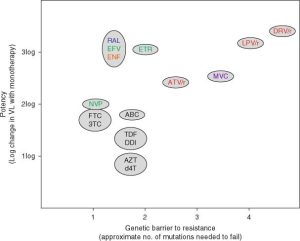
Different antiretroviral drugs require different numbers of mutations before clinically significant resistance emerges.
Low Genetic Barrier Drugs
These may lose activity after only one mutation.
Examples include:
- Lamivudine
- Emtricitabine
- Efavirenz
- Nevirapine
- Enfuvirtide
These drugs are effective but vulnerable.
Intermediate or High Genetic Barrier Agents
These require multiple mutations and generally resist failure better.
Examples include:
- Boosted protease inhibitors
- Darunavir
- Some integrase inhibitors
- Etravirine
These agents are especially valuable in salvage therapy.
The Role of Adherence in Resistance Development
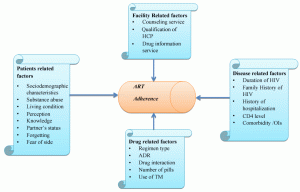
Suboptimal adherence is among the strongest predictors of resistance.
Insufficient adherence can:
- Reduce drug exposure
- Permit viral replication
- Create fluctuating selective pressure
- Promote sequential mutation accumulation
Importantly, the relationship between adherence and resistance differs by drug class.
For some regimens, resistance emerges at moderate adherence. For others, very poor adherence simply leads to treatment failure without selecting resistant mutants.
Understanding this distinction is critical in clinical management.
Clinical Consequences of Antiretroviral Resistance
Loss of Virologic Control
The most immediate consequence of resistance is reduced treatment efficacy.
When resistance develops:
- Viral load rebounds
- CD4 recovery may stall or reverse
- Disease progression risk rises
This undermines one of the fundamental goals of ART.
Cross-Resistance and Therapeutic Attrition
Resistance mutations often affect multiple drugs within the same class.
This phenomenon cross-resistance can dramatically reduce future treatment options.
One failing regimen can compromise an entire drug family.
This creates a dangerous therapeutic cascade:
- Initial resistance emerges
- Virologic failure occurs
- Additional mutations accumulate
- Future regimens become progressively weaker
This “vicious cycle” is a major driver of multidrug resistance.
Public Health Consequences
Resistance is not only an individual problem.
Drug-resistant HIV can be transmitted to others as:
- Primary resistant infection
- Superinfection
This complicates first-line treatment at a population level.
Thus resistance management is both:
- Individual patient care
- Public health prevention
Principles of Clinical Resistance Management
Prevent Resistance Before It Emerges
The best resistance strategy is prevention.
This includes:
- Baseline resistance testing
- Rational first-line regimen selection
- Maximizing adherence
- Early viral load monitoring
- Rapid response to treatment failure
Preventing resistance is easier than rescuing failure.
Resistance Testing as a Core Clinical Tool
Drug resistance testing has become central to HIV management.
Its objectives include:
- Detecting transmitted resistance
- Guiding regimen selection
- Identifying causes of virologic failure
- Optimizing salvage therapy
Genotypic Testing
Genotypic assays identify resistance-associated mutations.
They are widely used because they are:
- Rapid
- Practical
- Cost-effective
They should ideally be performed:
- At entry into care
- Before starting therapy
- At virologic failure
- During pregnancy when indicated
Challenges in Resistance Interpretation
Interpreting genotypes is often complex.
Challenges include:
- Mutation interactions
- Minority variants below detection thresholds
- Incomplete genotype–phenotype correlations
- Fitness effects of mutations
- Hypersusceptibility phenomena
Because of this, expert interpretation algorithms and machine-learning tools increasingly support clinical decisions.
Management of Primary (Transmitted) Resistance
Why Primary Resistance Matters
Transmitted drug resistance can compromise first-line ART before treatment even begins.
In some regions, primary resistance affects roughly 8–19% of newly infected individuals.
Most commonly involved:
- NRTIs
- NNRTIs
- Protease inhibitors
Resistance to newer classes remains lower but requires surveillance.
Clinical Approach to Primary Resistance
Management aims to preserve durable first-line suppression.
Key strategies include:
Use Baseline Genotypes to Tailor Therapy
Therapy should avoid agents for which resistance is detected.
Consider Future Treatment Lines
Initial choices affect later options.
Good HIV management always plans beyond first-line therapy.
Integrate Resistance With Other Clinical Factors
Drug choice should also account for:
- Tolerability
- Toxicity
- Convenience
- Adherence likelihood
Resistance is critical but never the only variable.
Acquired (Secondary) Resistance
Resistance During Treatment Failure
Acquired resistance arises when viral replication continues despite therapy.
Its management has three major goals:
- Stop further mutation accumulation
- Restore full suppression rapidly
- Preserve future drug options
Why Early Switching Matters
Maintaining failing therapy can allow ongoing mutation accumulation.
Studies show continued failure under selective pressure can progressively erode remaining drug activity.
Therefore, early switching is often crucial.
Principles of Salvage Therapy
Modern salvage therapy generally relies on:
- At least two fully active drugs when possible
- High genetic barrier agents
- Use of newer drug classes
- Resistance-guided regimen construction
With contemporary therapy, even many patients with extensive resistance can regain viral suppression.